


A No-touch Phygital Gallery
2021 | Augmented Reality Interface
Summer internship project under HOL ( UX consultancy)
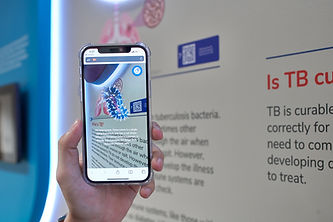
The NCID Gallery showcases how the centre has been built to manage both emerging and endemic diseases through a phygital experience. The National Center for Infectious Diseases (NCID) requested a contactless yet interactive exhibition, which led the team to decide on using Augmented Reality. I worked with HOL curators and UI/UX team to ideate an interactive AR experience within the exhibition space. There were 9 AR hot spots in total and each hot spot had a different interaction and visual.

2 challenges
on the road to a seamless UX
Lack of on-site information
The physical space was not fabricated yet, hence there is a lot of trial and error when it comes to user testing and ensuring AR content stability.
Too many QR Codes to scan!
For each exhibit, the user has to scan the QR code to the web-app before using the web-app to scan the exhibit’s AR marker before they can access the AR content. This could potentially confusing to first-time users.

Design user flow and AR scanning experience.
In order to get a clearer view of physical user traffic, we mapped out the position of all 9 hot-spots on the floor plan. Then, we came up with a numbering system to match each exhibit’s QR code such the QR code 1 corresponds to Exhibit 1 AR marker.

User-flow mapped with physical traffic: Clear numbering system to match digital experience to physical wall.

Each hotspot comes with an unqiue interaction. Users will feel like the executive of of NCID, Professor Leo Yee-Sin is standing right in front of you.


Kept the interface design as simple and minimal as possible as the priority of the interface should be the augmented reality experience, not the design of the interface. It was a challenge to balance between putting lengthy instructions on how to use the AR and keeping a clean interface.
Simple, non-intrusive user interface
Some learning points
Designers are the connecting bridge between people
Some days you are a designer, some days you are a stakeholder manager! NCID was the client and internally we had to work with curators, graphic designers, fabricators as well as software engineers. We had to run through our copywriting with the curators, and discuss our ideas with software engineers to confirm whether it is feasible before pitching them to NCID for approval.
Design is a constant process of learning and unlearning things.
In order to better understanding the inner-workings and possibilities of AR, the design team also attended a AR workshop held by the software developers. Indeed, design is a constant process of learning and unlearning things!